Tuesday, September 22, 2015

The Automotive Industry's Double-Edged Sword

(Image courtesy of Motor Trend)

The Automotive Industry's Double-Edged Sword
The good and the bad of higher limits, continuous advancements, and the nonstop power war


Exactly nobody was surprised when photos of the first wrecked Challenger Hellcat went viral, and it surprised even fewer that it was damn-near minutes after deliveries began. Out from all corners of the internet came cries of “it's too much power for the street and the average driver!” and along with it the car with the best name in recent history has forced us to wonder: how much is too much, where does it end, and is this the right path for cars to continue? This isn't just about the ultra-high horsepower monsters but rather the industry as a whole as it develops and advances at the sprinting pace it's maintaining. Making extreme power widely available and on the cheap, the Hellcat is just one example of this; it's a vehicle that single-handedly raises concern as to the general automotive trend and the subsequent good and bad that can and will come from the nonstop push for more power, speed, and flair. 
 And yet this is about more than just the Hellcat; seemingly every manufacturer is taking a turn in the headlines with an audience-capturing “wow factor,” be it any of the statistics or lap times or price figures that were once unthinkable; it's a time when every aspect of the car world is tapping into depths we have yet to prove positive or negative in the long run. But where will we find ourselves as the crossroads of “it's enough already” and “there's no such thing as too much” finally come together? Read on and let's explore this automotive conundrum. Oh, and to contrast the above-mentioned crash pictures almost poetically, a video of Ralph Gilles' first-through-third burnout from the same car's press event caused much drool and a widespread checking of bank accounts. Not that I'm guilty of either.

Jump with me and let's explore...

Sunday, September 20, 2015

That time Sir Stirling Moss signed two fans' cars "just because" [& I was there] - Historics @ Lime Rock Park 2015

Nestled deep in the hills of Connecticut lies a fantastic track, one worthy of much more attention and praise than it regularly garners. With a car-guy father and family friends who own/operate a race team that calls Lime Rock their “home track,” I’ve been going to the Road Racing Center of the East my entire life, but it was just this year that I became a volunteer at the place that holds many of my oldest car-related memories.
The Historics Festival is the park’s biggest weekend of the year, with events ranging from a Concours-style car show to full-on vintage racing. It’s a spectacle to say the least, and one that I’d call “mandatory” to witness at least once if you live in the region.
Continue after the jump for pictures and stories from a great weekend.

Tuesday, June 2, 2015

Ten Reasons Muscle Cars Are Here To Stay

TEN REASONS WHY MUSCLE CARS ARE HERE TO STAY
And none of them start with “'Merica”


The cliché is everywhere: “enjoy it while you can.” It's as if being green, efficient, and environmentally responsible have fully overthrown loud, rude, and in-your-face as the proper image you're supposed to portray to the world. Even Miley Cyrus is struggling to get away with acting such ways, and it's no secret that muscle cars are the vehicular portrayal of many of these frowned-upon traits that our politically-correct society suggests are better pushed aside. In turn, this puts our beloved muscle machines in grave danger; many doubt their future entirely and from a logical standpoint things look grim. But automotive enthusiasm isn't logical. We've all heard it before, even straight from the mouth of James May (the “sensible one”) in the opening conversation of Top Gear's most recent season, when he put it bluntly: “the V8 could soon be a thing of the past.” But I call bullshit. The most famous and storied of enthusiast-focused vehicles are going away no quicker than the Prius is becoming the Official Vehicle of Good Drivers. Here's why...

(Note: For the purpose of this article, the Camaro, Mustang, and Challenger will all be categorized as “muscle cars.” While each is muscle-esque in its own way(s)-- and while each strays from muscle in many ways as well-- for the sake of simplicity, they will be categorized together.)

First, past fuel crises couldn't kill the V8. Today, up against the toughest standards yet, they're still alive and are stronger than ever. While automakers disguised past fuel-efficient replacements by shrinking the car versus doing so to the engine, a la Gremlin, modern technology has enabled today's muscle and sports cars to exceed the MPG numbers of some the old-time “econoboxes” that resulted from the fuel crisis eras. High-20's MPG figures are easily achievable with a timid right foot, and some are handily creeping into the low 30's-- territory once, and even very recently, reserved for cars with efficiency as a high priority. Now, though it may not be filed under “intended use,” you can eek out sufficient miles per gallon from your “play toy” for it to still be fairly economical.

Second: there's a future of muscle cars that burn rubber without burning gas. The first Tesla Model S was a land-going, battery-powered rocket ship, and now they've “launched” (ha) the P85D, featuring the infamous “Insane Mode,” a drive setting based on Elon Musk's desire for acceleration matching that of the McLaren F1. Acceleration as a priority? Straight muscle car mojo, be it roaring exhaust or whirring batteries. That kind of power in a smaller, lighter chassis with two less doors and rear-wheel-drive would be fan-freakin-tastic, and the potential for this to be built is proof that a muscle car can exist in a world where being green is hip. It's really just a matter of time before we start seeing Electric Muscle...paging Mr. Musk...

Third, while the typical automaker usually sells fewer halo cars than they do any other vehicle in their catalog, the vehicular icon that represents an entire brand is an entity wholly capable of drawing somebody into the showroom which in turn can generate a sale of either said halo car or, more importantly, of something beneath it. For example, if somebody walks into a Dodge dealership to oogle their Viper-filled fantasy and reality-laden sensibility kicks in, he can still likely justify a Charger as his family car while keeping peace of mind that his pride and joy shares blood with its Hellcat and snake-bitten Dodge brethren. Halo cars create sales of the cars that automakers actually make money on. In the form of muscle cars, they create prestige by giving the other cars the company builds the image of having the same heritage as the more “desirable” car. Brand recognition and image are both extremely important, more so now than ever, and it all starts with the company's most easily recognizable and distinguished car. And if people think they're getting a piece of the fun by purchasing a relative of a sports or muscle car, it's a win-win for the company.


The halo car effect also incorporates itself into the CAFE-standard ordeal; while the V8-bearers might not achieve an average efficiency worthy of meeting the government's mandates, the high-volume sellers are more likely to increase the company's overall average fuel economy, allowing the parent brand to meet said standards and live to see another day. We must not forget that vehicle manufacturing is a business and that automakers need to sell cars to survive, and it is impossible to do so without complying with the government's regulations.

Fourth: Speaking of selling cars, numbers speak volumes: Chevy has sold nearing 500,000 Camaros since the car's reincarnation, while Dodge has moved going on 300,000 Challengers during its newfound life. And, needless to say, Ford has been selling the Mustang nonstop since its introduction, with numbers just behind the Camaro since the Chevy's 5th generation was introduced. These high sales figures drive (so-to-speak) and correlate to the sales of the rest of the product line, and to that of the industry as well. And right now, the resulting numbers are quite good.

Fifth, the kids that will keep car culture going are the ones who embrace muscle cars with open arms and open hearts. They're the ones eagerly awaiting the all-new Mustang's release; they're the ones who geek out over the Z28's lap times; and they're the ones obsessing over the Hellcat's astronomical power figures. Car culture has changed quite a bit since the first coming of Muscle, but if it has any chance of survival it needs a core group of enthusiasts who still love the rumble of eight cylinders. Likewise, with muscle car ownership usually comes the territory of [willingly] doings modifications and maintenance oneself, and the comparative simplicity of V8's and the package wrapped around them makes these cars relatively easy to work on and also relatively affordable, thus positioning them as accessible enthusiast machines. The future lies in the hands of the up-and-coming generation, one that appears to already be accepting of the V8 and of muscle.

Sixth: muscle cars are no longer the one-trick-ponies of yore. When the original Mustang and Camaro debuted they were focused on acceleration, an affordable price tag, and high fun-quotient. But today, with competence tests such as autocross, time attacks, track days (bro), and the likes, modern muscle has to be able to turn too. As such, the automakers have obliged; enter the Camaro 1LE / Z28, Mustang “Track Pack” / Boss 302 / GT350[R], and even the SRT/Hellcat Challenger [and yes, Charger]. Any and all of these cars' dynamic abilities will punch the “American cars can't handle” guy square in the face. Even the Hellcat ran around Motor Trend's figure-eight in the same time as the Alfa 4C, a car dedicated to weight savings by making use of carbon fiber shell, quite contrary to the Hellkitten's close-to 4500-pound heft. Visit a local track day and you will undoubtedly see an assortment of each from the Ford/Chevy/Dodge trio fighting physics in a battle against the clock. In addition to handling prowess, these American bruisers employ some tech that would make the early days
of NASA seem unsophisticated. GM's Magnetic Ride Control uses magnetic particles that float in oil to control suspension damping 1,000 times per second. Meanwhile, even the Mustang has joined the 21st century with the addition of Independent Rear Suspension and all the accompanying toys to qualify it as a fully “modern car.” Then there's Dodge, which is selling a seemingly unlimited number of fully streetable 700+ HP monsters-- a concept which would have been ludicrously unthinkable as recent as a decade ago, before technology made a car with so much power “driveable.” And let's not forget the ever-increasing number of computers fitted to every vehicle. The bottom line is today, muscle is not only about ripping burnouts and slaying the quarter-mile, but it's about being able to conquer corners as well.


On top of this, muscle cars have become genuinely good on the street. They are truly easy to live with, and not just as in “oh yeah, it's fine for what it is,” but in that they're safe, comfortable, semi-practical, reliable vehicles. Compromises are, finally, minimal. I drive my Challenger every day, 105 miles round trip. It's perfectly comfortable, there's ample interior room for people to fit in the back if needed, and better yet, even with a 5.7L V8, averaging 22 MPG is easy. It's even seen figures as high as 29 MPG on a road trip, which was with the A/C on full blast and a week-long vacation's worth of baggage filling the trunk. The proof is there: more and more people are making V8, RWD cars their daily drivers. Traction control, ESP, and other acronym-bearing car brains also make these cars easier to drive year-round, inclimate weather included (with the appropriate tires, of course). Making the case for a muscle car as your only vehicle is no longer difficult; today, it's easy to justify how you can combine practicality and pleasure.

Se7en(th): Thinking outside the box, there's muscle cars from all over the world, not just from the good 'ol US of A. Mercedes represents itself with the C63 and SLS, both of which are notorious for being entirely overpowered versus their handling/chassis departments; Lexus is building a coupe with a 460+ HP V8 and far too little tire; and even Britain has pseudo-muscle in the F-Type R Coupe (the now-defunct RWD version, at least) and some of the Aston Martin cars as well. Broaden the spectrum to GT cars, the concept of which is largely similar (big engine; comfort; rear-wheel-drive; effortless low-RPM cruising; fun; etc), and there are even more options. On the flip side, the “hottest” thing to do today is to swap a fire-breathing V8 into a shell otherwise left to smaller means of propulsion, in turn broadening muscle's influence if only through the hands and minds of madness. What was once an American-only club has gone fully international, with more entries and creations on the horizon and each one making the competition more difficult, thus forcing improvement in every facet. More muscle in the wide world of cars means it's that much harder to get rid of.

Eighth: the sound. Nothing can replace the raw, brutal, grass-roots arrogance of a V8 engine piped through proper headers into a not-so-muffled exhaust. Be it a V12, V10, straight-six, or turbo-4, every engine type has a following, but none has a sound as iconic as that of eight cylinders. Small block or big, the V8's roar is ingrained in songs, movies, and, most importantly, minds, and it's part of why people love muscle cars in the first place.

Ninth: muscle cars are badass. They ooze character and personality. They make good movie cars. They make auto shows important. They get your attention, be it in a commercial or in a parking lot. They make heritage and nostalgia and brand names and rivalries relevant. And they make having a shit-ton of attitude feel like a vital part of life. Hollywood, form over function, and competition: staples of American society that will never, ever go away.


Tenth: smiles. Car enthusiasm is about automotive bliss, being happy around cars, losing oneself in the sights/sounds/feelings, making friends (and enemies), experimenting, trying (and failing), about the grin you get from all of the aforementioned...and, of course, the incomparable connection between you and your car and the road and the freedom that takes perfect form in driving. Muscle cars simply make all of this better. That's really all there is to it. Whatever obstacle there is people will find a way to keep muscle cars around for they enrich lives in a way that only muscle cars can. If this isn't reason enough as to why they're here to stay, I don't know what is.


Despite ever-tightening standards, times, for cars at least, are good. The horsepower wars are swinging harder than ever. Innovation is running wild, hand-in-hand with old-school mentality's greatest hits. Ford, Chevy, and Dodge are fighting harder than ever to make the best cars they can, and not just those with unnecessary amounts of horsepower and torque. But luckily they are focusing on those with unnecessary amounts of horsepower and torque, and we the car people are reaping the benefits. Times are good. No, times are great. Perhaps the best. This is the true golden era of muscle. Muscle cars are too iconic, too blue collar, too laugh-inducing, too enjoyable, and too damn fun to ever go away for good. The outlook is equally great: we're witnessing a new standard, with even better machinery on the horizon. Muscle cars are here to stay. They've adapted before and will have to again, but for now all we can do is enjoy them, because it's not a matter of doing so while they're still around-- it's a matter of enjoying them while we're still around.  Let's face the facts:
Muscle cars are here to stay.
And if you've made it this far, go do a burnout.


-Ross, 6/2/15

Image sources: Google / myself

Tuesday, April 21, 2015

Separation Anxiety: How A Rental Car Rejuvenated My Automotive Enthusiasm


Separation Anxiety
How three days with a rental car rejuvenated my automotive enthusiasm and concurrently my love for the Challenger

There's really nothing wrong with the midsize-crossover that is the Dodge Journey; in fact, it does everything it's intended to quite well. It's safe, reliable, moderately comfortable, roomy, returns decent gas mileage, is made of materials that were unknown to many manufacturers as recent as ten years ago, and (probably) hauls five to seven people, two of those being very small children, just fine. Fundamentally speaking, it's a good car. But if you're reading this, it's pretty likely you consider yourself an automotive enthusiast, otherwise known as someone who takes particular interest in vehicles that are rather good at sacrificing their ability to be a car in favor of novelties such as lap times or crawling over inanimate objects. And, unfortunately, that doesn't make the Dodge Journey a good enthusiast's car. Yet despite this, it was remarkable how living with one of these “sensible vehicles” for just three days helped rejuvenate my love for cars, and especially for my own. It all started with a usually-run-of-the-mill, though unpleasant, telephone exchange:

“We'll likely have to keep it until Tuesday or Wednesday of next week.”
“Shit.”

It was the end of March. The Winter Blues had officially assumed full command of my psyche, the snow-covered woods and leafless trees a visual reminder of weather suited best for those who enjoy places the likes of Vail, or whose favorite company is a hardcover epic beside the warmth of a fireplace. And, just as things are looking up – a couple days breaking the seemingly summer-like forty-degree mark – in comes the Dodge Journey, taking the place of my Challenger during its inpatient stay at the dealership for transmission surgery. Quoting a lead time of about a week, the service advisor helped me scoop up a rental in the meantime, though my initial emotions were very misleading. The excitement of potential seat time behind the wheel of a different vehicle wore off very quickly, evaporating entirely when the Caddy ATS and Chrysler 300 on the Enterprise “menu” faded out of view as the rep pulled a straight-jacket-white Journey SXT out to be my temporary wheels. Only a few minutes later, with less than two miles spent sitting in the driver's seat, the feeling was instantly recognizable: it was as if the steering wheel was connecting me to something that wasn't, well, me; I was no longer driving an extension of myself, but rather simply controlling a piece of machinery.

To use a worn-out cliché, the Journey, especially in rental-guise, is effectively an appliance. Its purpose is A-to-B transportation, nothing more, nothing less. It stirs about as much emotion as does running the washing machine, which is next to none, unless you're a dog...which you probably aren't, unless this is some strange post-script from The Art of Racing In The Rain. Coincidentally, the aforementioned is a book that fully encompasses how being a lover of all things car can seize your body, mind, and soul; driving is wholly capable of bringing about adrenalin, joy, fear, sorrow, and everything in-between. To those who love them, cars come alive. Unfortunately, the loaner did not, but it rejuvenate deep within me the passion that burns so strong, which was waning amidst the brutal Northeast winter.

Before I knew it the Journey was gone and my butt was planted in the driver seat of my Challenger once again, putting me on the receiving end of many more stares from middle-aged men and feeling much less like I was heading to pick my kids up en route to drop them off at whatever practice it is they might be going to. The Journey was hardly with me long enough to drive it, to get to know it, and to bond with it, let alone to take pictures of it or do things like calculate the gas mileage it may or may not have gotten (hey, you gotta wind out the gears at least a few times). No hurt feelings here, for the time spent in the blandmobile made driving the Hemi-powered R/T feel infinitely more responsive and (thankfully) faster than it usually does, and the involvement of the manual transmission a revelation. However (and this is still much to my surprise), I now have a deep, new-found appreciation and respect for the Dodge Journey. Not for the Journey as a model, but for the specific vehicle I had for three days while my car was at the doctor. Though driving said Journey failed to stir up any vehicular emotion in the bottom of my soul, it did revive that which beats for the real world of automotive enthusiasm; it allowed me to realize, recognize, and remember just how great the world of cars is, and why I call it my favorite pastime. It rejuvenated the desire for road trips, for track days, for car shows, and for the seemingly simple things like waving at another driver of your same model car as they drive by. A vehicle may not have a living, beating heart, but a soul it most definitely has.

These few days also bump-started my love for the Challenger that has become a willing and able partner to my road-borne adventures. While outspoken internet desk-jockeys argue that it's too heavy to be a good car for enthusiasts, I entirely disagree. Actually, I've always disagreed, but more so now than ever. It might not have the dynamics of a Miata, the drama of a 458, the acceleration of a GT-R, or the road-and-track-compatability of a 1LE, yet it's still a good enthusiast's car. Not necessarily driver's car, but a lot of that is what you make of it; rather, it's what you do with it that makes it your vice, your channel, your way of expressing and enjoying yourself. And though the heavyweight Challenger might not invigorate you to set the new lap record at Laguna Seca, what it does do is inspire you, just as any great car or driving partner should: it makes you want to drive, crave a reason to go places; it forces you to enjoy the adventure and not just the destination. And this, friends, is what being addicted to motor vehicles, to new experiences, to the culture, and most importantly, what driving, is all about.


It's easy to lose way of automotive culture when the weather is shitty, your car is broken, and your favorite motoring TV show has recently been canceled. At said point in the year, nothing seems further away than giving your car a bath, going for a drive, and reveling in the freedom that there is in making your own adventure. But then, just when you're at automotive rock bottom, something comes along and it hits you: nothing can replace the passion that is being a “car person,” because in it comes a one-to-one attachment that simultaneously helps you see, experience, and take joy in new things, and also helps you find yourself. If you need to get your enthusiasm back on track, if you're looking for a way to rejuvenate your passion for vehicles and for the art of driving, if you've got the Winter Car Blues, all you need to do is seek your closest rental location. You'll fall in love all over again before you know it. I recommend a Dodge Journey.

-Ross, 4/21/15

Wednesday, October 29, 2014

Tire Comparison & Review: Goodyear Wrangler DuraTrac vs. Toyo Open Country ATII (AT2)

Tire Comparison: Goodyear Wrangler DuraTrac vs. Toyo Open Country ATII (AT2)


Goodyear Wrangler DuraTrac
Trying to garner an unbiased opinion about which tire for a 4WD truck/SUV is “the best” is nothing short of asking Chevy, Ford, and Dodge owners why they’re partial to their respective brand – except in the world of tires, there's ten times the choices.  The number of all-terrain (A/T), mud-terrain (M/T), and crossover tires (a new genre, those that bridge the gap between the two) is seemingly infinite.  The good news is that it's hard to find a bad tire, but the flip-side is that deciding on a tire suited to one’s desired price range, load rating, tread pattern, domestic/foreign brand, size, look, etc. is bridging on the verge of impossible. Rather than explore the “safe options” (BFG A/T, Nitto Terra Grappler, Micky Thompson ATZ, General Grabber AT2, Cooper AT3, etc.), I’m going to get very detailed with two of the “hot tires” of the moment which, while not technically new-comers, are popular and well-respected in their own right.
Toyo Open Country ATII (AT2)
Furthermore, to help us differentiate between a tried-and-true “all-terrain” and one of the newfangled “crossover tires,” this comparison features one of each: Toyo’s ATII (the clear all-terrain) and Goodyear’s Wrangler DuraTrac (a mud-terrain with road-going manners, or an all-terrain that thinks it's a mud tire -- depending on how you look at it).  Both were 285/70/17, with the Goodyears being D load rating and the Toyos bearing an E.

In short, both of these tires will help you keep your 4WD bragging rights and off-road ability, but neither will make you feel like you were irresponsible in buying an all-out mudder for your rig that has to be able to handle street duty.  The following compare/contrast is here for those of us unsure as I was as to which type tire best fits their wants/needs.

APPEARANCE

No 4x4 should be wearing shoes that look like those commonly run on a minivan, end of story. The number of compliments and questions I got while running the DuraTracs became borderline absurd. People asked, “what are they?,” “how do they do in the mud/snow?,” “where can I buy them?,” and on and on and on. They simply look like nothing else out there and give off an air of aggression that even some mud tires can’t match. The tread pattern seems to mimic that of the bottom of a Timberland boot (a real Timberland)...all good stuff here for the Goodyear, and the pictures speak for themselves.


While the ATII’s sidewall isn't overly menacing, the tread has enough meat and depth to it so that you won't mistake it for something stock. This doesn't look like a tire you want to attack the Rubicon Trail with, but you probably wouldn't hesitate to run it through some mud, decently deep snow, or do some mild wheeling with it. Think “street tire with lugs that are open enough to clean out fairly well.” It’s tame and understated, but not weak. Still, it can't match the absurdity that is the Goodyears' design.

Advantage: DuraTracs - no question here

AROUND TOWN

It's easy for a tire with an aggressive tread to wobble at low speeds, especially when accelerating and decelerating between a stop and 10 MPH. Luckily, the spacing and pattern of the DuraTrac minimizes this...when compared to something geared even more towards off-highway use. The lugs are positioned close enough together so that the voids don't cause a shake or wobble, and since it doesn't have a totally horizontal layout (ex. Super Swampers), vibration truly is minimal. The Pro Comp A/T’s I had years ago were worse.
Even with its Load E rating, the Toyo is undoubtedly smoother around town, sometimes eerily so.  Additionally, the tires help to eliminate some of the smaller disruptions in pavement that you would otherwise feel in your lower back. Very refreshing after 25K miles with the DuraTrac.

Advantage: Toyo

HIGHWAY CRUISING

Be it the regular commute or towing the quad trailer, a good tire has to inspire confidence in you when you're moving at speed. It really does help to know you won’t suddenly wander out of the lane, and it’s also nice to feel that in a panic-stop situation the tires under your vehicle will work to your advantage.

With low mileage on the set, the DuraTracs were surprisingly pleasant and had good characteristics overall at higher speeds: wander wasn't bad and braking distances were “good enough.” They did, however, squirm a fair share under hard braking, which only got worse over time. Overall, highway quality was decent but dropped off quickly after 20,000 miles, the point at which they became drastically worse riding and exhibited some characteristics – wander, bad braking distances, excessive noise – that were enough to force me into buying a new set (they were replaced by the Toyos).

On the contrary, the Toyos performed admirably on the highway. Wander was even less than the DuraTracs, braking distances were great for a tire of this genre, and they were smooth riding and coasted with ease. Honestly, these tires portrayed the best driving characteristics of any tire I've ever owned, aggressive or not.

Advantage: Toyos

NOISE

Noise is commonly a big issue when dealing with truck tires in plus-sizes. Highway hum can be overly aggravating if you're not accustomed to the noise of the M/T's, and it can truly make you enjoy the time spent in your vehicle less than you otherwise would.

The compound Goodyear uses for its DuraTrac is much softer than that used by Toyo in the ATII, and such is one factor why it makes a lot more noise. Furthermore, the open, criss-crossing tread of the DuraTrac does itself no favors here. Chalk it up to the Goodyear being geared more towards traction in off-road situations, prioritizing grip and ability over pleasantness. Still, it could be worse; the DuraTracs are noticeably quieter than the typical mudder.

As quiet as the Goodyear is for a tire of this style, the Toyo is drastically quieter, silent to extent that you almost forget they're rotating continuously beneath you. To call the DuraTrac bad in the noise department is a totally relative statement, because Goodyear has made a valiant effort in helping the DuraTrac to be easy enough to drive around on without them humming your ears off. Meanwhile though, the ATII is outstanding when it comes to road noise. Again, different styles, different purposes; these only become more obvious as you spend more and more time with each.

Advantage: Toyo

HANDLING

Yes, this does matter when it comes to trucks;, seeing as nobody wants their vehicle to feel sloppy going around a corner even if said vehicle weighs upwards of three tons. The DuraTracs, with their soft makeup, did well on mountain roads and really gripped the pavement when pushed hard. Likewise, the Toyos did mighty fine for a tire not designed to be driven like you would a sports car, but that didn't stop me from doing so when the Avalanche was my only vehicle. The one big difference between these two was that the Toyos were much more progressive in their limits whereas the Goodyears would hang on and then give up suddenly with little to zero notice. Either way, unless you're on a race track, both tires do very well, better than one would even expect. The nod goes to the Toyo though, for having less sidewall roll in the corners and for being more forgiving in their ways when driven hard.

Advantage: Toyo

BRAKING

Be it in slow-speed traffic, at cruising speed, or especially with a trailer hitched to the back, braking performance is crucial when it comes to truck tires, if not the most important aspect. Here the Toyos reigns supreme, with absolutely zero drama to them and dead-straight, worry-free stopping qualities. The DuraTracs, while largely problem-free, do squirm a little under hard braking which is only worsened when there's a trailer behind the truck. It's nothing that would be considered “worrying” and they really are competent enough to handle any kind of towing duty you can do with your light-duty vehicle, but if you know you have to slam the brakes often it's something to consider. Both are good, but the Toyo continues to shine when it comes to on-road personality.

Advantage: Toyo

RAIN, SNOW, AND ICE – HARSH DRIVING CONDITIONS

Presumably you also drive not only in good weather, but in the bad as well: rain, snow, ice, and the like. You don't want your truck to let you down, and you expect the same from your tires.

Rain should be fairly straight-forward: hydro-planing is bad, end of story. Luckily, neither of these tires showed even the faintest sign of inability to cope with water on the roadways, be it constant rain or post-downpour standing water. And both tires will, when given the cattle prod, handle wet-condition drifting with ease (a friend told me this). I'd probably choose the DuraTrac though, for it stays a little more sure-footed when coming across puddles in the road.

Snow is probably my favorite condition to drive in, but while stepping the back out in the winter is hysterical childish fun, you want to feel safe when you're not fooling around. Let's start with how the tires perform in a dusting: in 2WD the DuraTrac does well, though it gets a little tail-happy when you're hard on the gas and the snow is light. The Toyo is similar but to a lesser extent. In 4WD the tires handle light snow flawlessly (really as if it isn’t even there). Medium-depth snowfall is similar, with the DuraTrac pulling a slight lead as the Toyo's lesser ability to clean out becomes evident. In deep snow, however, the tires' differences suddenly become major: the DuraTrac will go places in 2WD where the Toyo requires the extra two front wheels spinning.  There's pretty much no snowstorm that the Goodyears can't handle once you engage 4WD, and it's reassuring to know you can still get wherever you need/want to go when the winter weather suddenly turns bad. I live at the top of a massive hill and there were situations in which the Toyos required the handy 4WD switch when I could still make it in 2WD with the Goodyears and some modulated wheelspin. Summary: the DuraTracs definitely portray the better snow-going abilities and were a more competent drifting companion as well.


Advantage: DuraTrac

OFF-PAVEMENT

Pardon the poser pic...
You don't have to be an expert in tires to know how this is going to go. Just by glancing at the two tires side-by-side it's almost laughably easy to tell that the DuraTrac will perform better off-road. A more intricate pattern, more openly spaced lugs, more aggressive sidewalls, and a softer compound all help contribute to the DuraTrac's benefits versus the Toyo's closer lug spacing and harder-composition. Put simply, this is a matter of being deliberately designed for more off-road use, and it shows. Here's a *quick* breakdown of off-road characteristics:

Mud: Toyo has obvious disadvantage with more road-friendly tread; DuraTrac does well and cleans out as one would expect.
Rocks: DuraTrac likes to throw rocks hard and far but otherwise climbs like a mountain goat. Soft sidewalls are concerning, though. Toyo does well on rock-only surfaces but doesn't like climbing as much due to harder makeup; also picks up many smaller rocks in tread-blocks and holds them there.
Fire roads: DuraTrac holds straight and reacts well to inputs, whether small or large. Toyo rides more harshly and is twitchy at speed. Drift-ability is a wash; the DuraTracs drift better at higher speeds and the Toyos are more cooperative in low-speed sideways action.

Advantage: DuraTrac

TREADWEAR

Tires don't last forever. Just like the cars or trucks they ride under, every model has a lifetime and, accordingly, that varies based on many factors. Composition, hard/soft, tread pattern, and others (especially driving style) have an effect on how long a particular set will last, and the two sets in this comparison are no exception.

At 20,000 miles or so, the Goodyears took a quick turn for the worst; by around 25K, they were showing heavy signs of wear: low tread, increased noise levels, and worsened braking/handling characteristics. 25K would be decent for a mud tire but it's a little disappointing here, where I expected 30-35K. And though I must admit my driving habits were no help to longevity, 25K equates to basically a year's worth of driving for me. That's not a lot of life out of a set.

On the contrary, the Toyos seem to have endless life in them. As of this writing there’s ~20K miles on the set and they look just as they did when they were brand new. My dad has the same tires (down to the size and load rating) on his 2500HD Silverado – a much heavier truck – and his set was just starting to show wear at around 50K miles, and that's with a fair share of towing and hauling. At this rate he will get 60-65K out of them before he buys another set, and I wouldn’t be surprised if the set on the Avalanche lasts even longer. This is shockingly good, and acts as a financial benefit as well.

Advantage: Toyo

PRICE/VALUE

Truck tires are, in a phrase, painfully expensive. $1000 for a set is totally commonplace for plus-sized kits, and your wallet will suffer accordingly. In identical sizes, Goodyear charges a fair amount more per tire – about $30-50 depending on the source – than does Toyo. It would be fair to argue that those who prioritize off-road performance are willing to pay more for their rubbers to minimize the hit in on-road performance and, for how well it performs, the DuraTrac is priced competitively versus other tires that only do slightly better when the pavement ends (yet struggle to hold themselves together at all when hitting the highway). For the price, the DuraTrac is a great value.

As for the ATII, Toyo has managed to create an incredibly long-lasting, quiet, pleasant, all-weather-capable tire that looks the part and is up to the off-road task 75% of the time. At $30-50 less per tire than the Goodyears and with a lifetime of about 25K longer per tire, Toyo scores extremely high in the value factor. It's a great tire that will last long past the point at which you're thinking about your next set, and performs well along the way.

Advantage: Even (both pose great values in their own right)

CONCLUSION

After spending years with both of these tires under the same truck, it's easy to hone in on where one betters the other and which is best in each discipline. It's impossible to belittle the Goodyear DuraTrac's off-road capabilities, but ignoring the Toyo ATII's on-road dominance wouldn't be fair either.

It comes down to this: if you drive your truck daily and really don't off-road it that much, stick to the Toyo Open Country ATII (AT2); its longevity and road manners are simply outstanding, it doesn't flop on its face when the going gets tough, and it'll never fail you in its duty. However, the Goodyear Wrangler DuraTrac is a great option for the guy that wants the off-road look (or abilities) without the tradeoffs that typically come along with a dedicated off-road tire. It manages to handle regular on-pavement driving just fine, and adds a menacing look to any vehicle.

What we can conclude from this comparison is that the age of off-road tires having horrid downsides is well past us. Modern light-duty truck tires are in fact capable of multiple responsibilities and can in fact look good doing so. Additionally, this comparison has proven how different two tires that show up under the same grouping on a website can actually be. Both of these tires prove that retaining road manners is not mutually exclusive from performing well in winter weather conditions or when wheeling your rig, and also that it is possible to justify a somewhat more aggressive tire even if it's not what suits your driving best. Hats off to Toyo and Goodyear for two great creations.


Oh, which would I buy? Probably the DuraTrac, even though the Toyo undoubtedly suits my needs better.  I just can't get over how great the Goodyears look; in writing this article I realized I had taken easily 100 times as many pictures of the truck with the Goodyears than the Toyos, and with how minimal the trade-offs are, I would willingly suffer through a little extra road noise and shorter treadlife to love how the truck looks.

-Ross, 10/29/14

Edit: 11/12/14 - for proper/improper use of term "directional"

Wednesday, October 1, 2014

Review: MBRP Single Side-Exit Exhaust for 5.3L V8 GM engines (w/pictures & video)

For when your limited budget parallels your disregard for manners


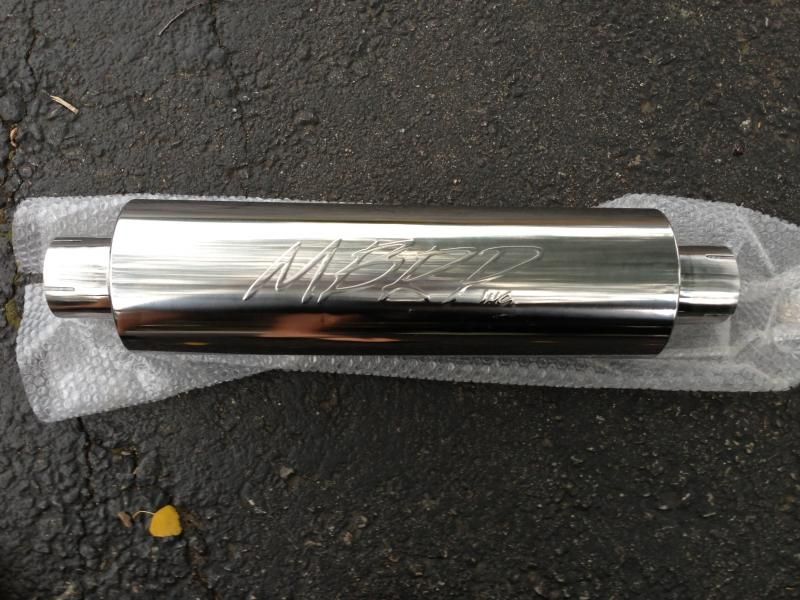
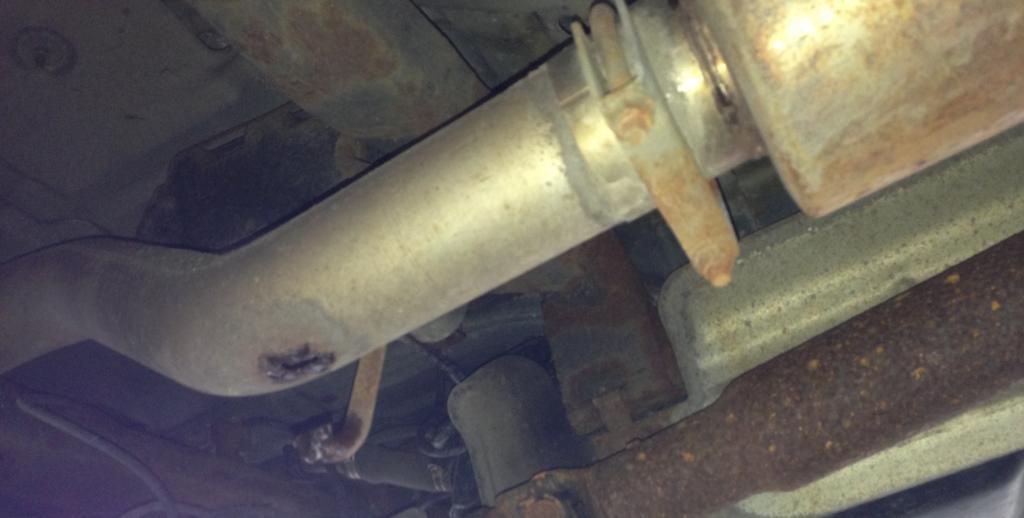
Those of us that live in the snow belt are far too familiar with the moisture-and-road-salt-induced rust that eats away at the underside of your winter-battling car or truck. Yet until scientists devise a practical, wide-scale way to treat the roads and effectively prevent such oxidization, we're stuck with snow plows, sanders, and the crappy road surfaces that result. As such, rust inevitably takes its toll on your vehicle, and my Avalanche was no exception. Exhaust system after exhaust system corroded past the point of repair and late in the winter of 2013, the same happened yet again. This time, a strict budget and the recent disintegration of a custom-bent “shop-floor special” in mind, I decided to try a mass-made example from a reputable company. Many forum threads and a $297 Amazon charge later, an MBRP Single Side-Exit Cat-Back exhaust system was en route to its new life fixed to the undercarriage of my Avy. This would mark the fifth aftermarket exhaust system I've had experience with on a 5.3L GM truck motor, in the order of: Gibson, Magnaflow, two random shop-floor custom-bent examples, and now the MBRP. Having gone through the same process so many times, it's safe to say I'm no stranger to the wide world of using a V8 Chevy truck engine to make noise. How did MBRP's budget-minded kit fare? Let's find out...
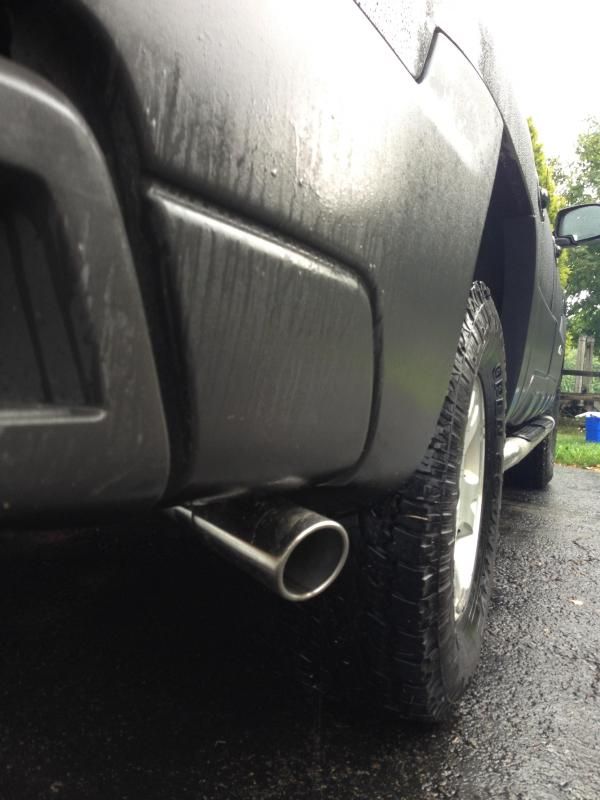
With tip installed

Style/Looks/Appearance
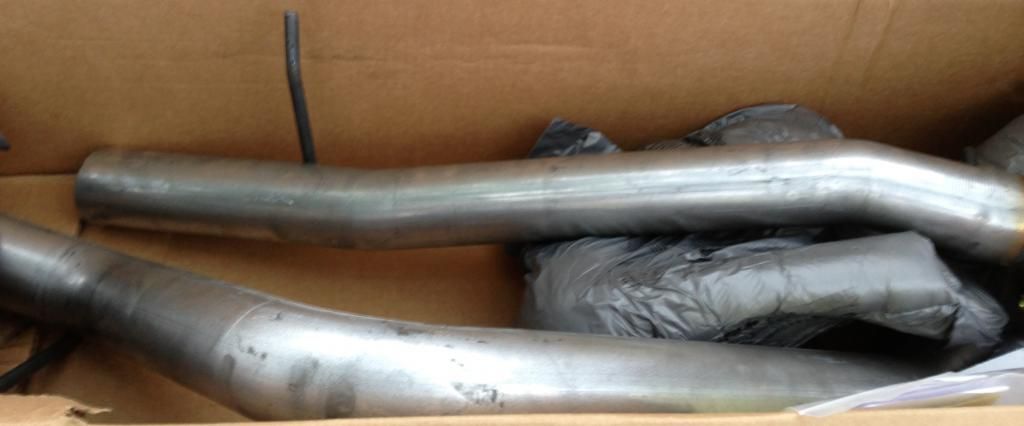
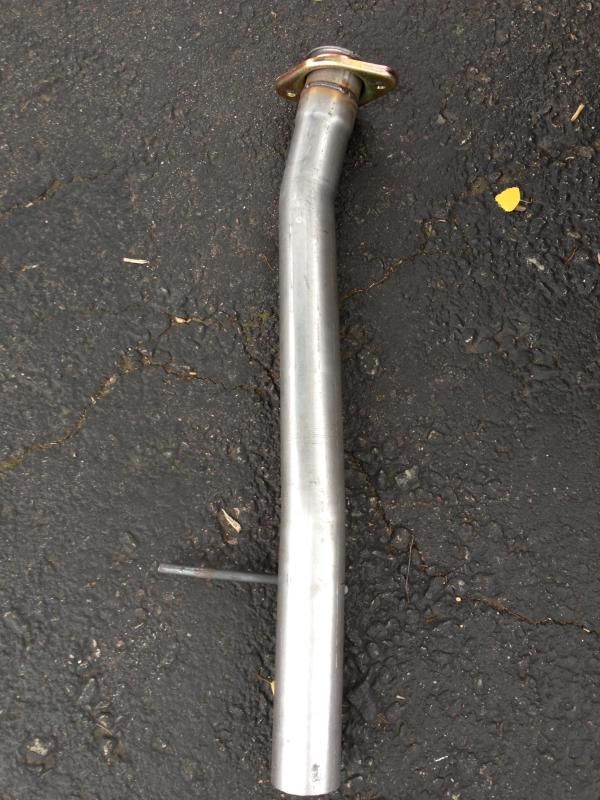
What we have here is the basic “swept-side” single-exit, which is a fancy way of saying it occupies the same location and has the same style as the factory system. Some like the stock look, others don't; to each their own. The factory-spec appearance does have a “stealth mode” draw to it, and it forces you to focus on the other traits that can really set it apart. Up close the pipes are nicely made (and look much better painted black...more on that later), with nice bends and clean welds. Nothing of show-quality here, but it doesn't look like a hack-job either. Running it without the provided tip creates an even smoother, almost-hidden look, which is fairly badass in my opinion.
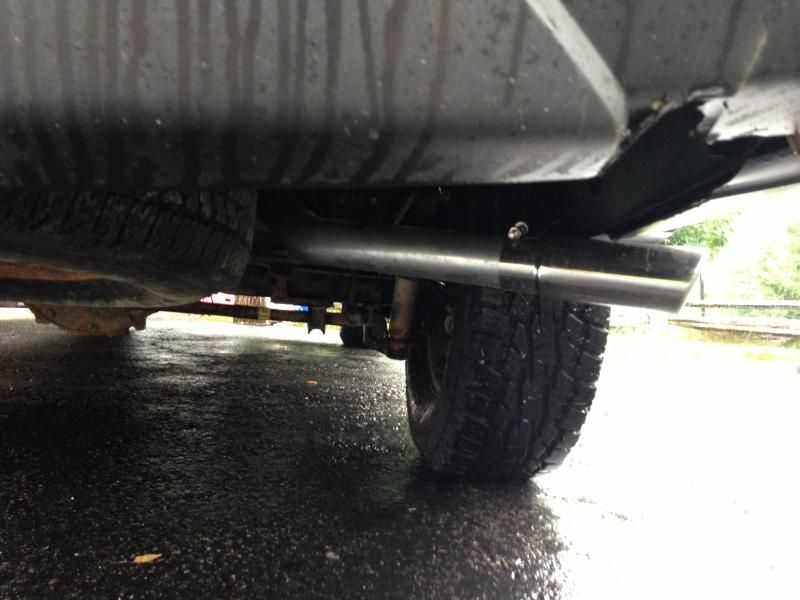
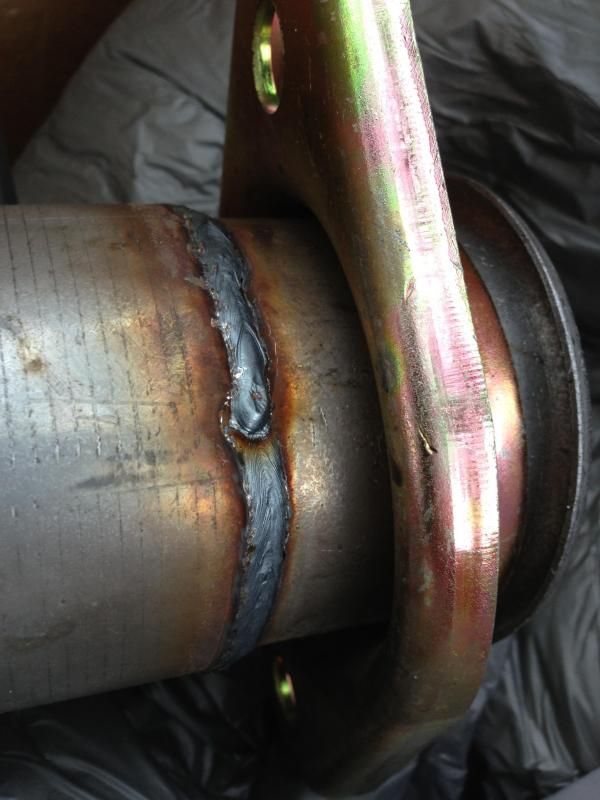
Score: 4/5


Sound
People generally fit into one of three groups: those craving a NASCAR-style sound, those who want dead silence, and those looking for the “perfect pipes,” which roar when revving and under hard acceleration but packing a quieter demeanor on the highway or when simply cruising along. I fit into the third demographic; there's nothing that can replace a V8 rumble and I absolutely wanted to hear my truck's engine bellow when hitting the loud-pedal, but regularly blowing my eardrums during my eighty daily highway miles wasn't appealing. Hoping for the MBRP to fit into this formula, it didn't turn out to be perfectly on-point with what I had been looking for.

So, how does the MBRP sound? On startup it's not unlike an LS-series motor: thunder upon turning the key, followed by a smooth settling, and an almost subdued but evil character when sitting at idle. Rev the engine and it speaks directly to your inner straight-pipe craving. In gear, though, full throttle produces a sound that is undoubtedly more pleasant on the outside than the inside; there's no escaping the bellow, and inside you lose much of the guttural growl.


Despite this downside, there is a notable upside: deceleration from higher in the RPM range results in barks and pops that are reminiscent of the truck's bowtie-bearing siblings with names like “Corvette” and “Camaro.” (You can hear some of this in the video.) It does indeed evoke muscle-car thoughts, and this is possibly the MBRP's strongest point. Overall, it makes good sounds, those that are only disappointing when you're behind the wheel and on the relentless on the accelerator.
Sound: 3.5/5

Drone
Here we have a bi-polar being. Cruising while very low in the RPM range is quieter-than-expected, dare I say even pleasant? Under slow acceleration the noise is audible over the radio, but not overbearing; however, hit a slight incline where the engine is taxed even minimally and out comes every bit of the drone you know has been hiding somewhere in your ears' nightmares. From the middle to the higher end of the powerband there's a semi-unpleasant, very loud sound the emanates everywhere, and you can't do anything about it unless you manage to trick the automatic transmission into upshifting, or turn the radio up to damaging levels. The sound is so prominent and there's simply *so* much of it that you find yourself subconsciously doing everything possible to avoid hitting this range. Bottom line: it's most certainly not for the faint of heart.
Score: 2.5/5

Performance Gains
No, adding an exhaust system won't give you noticeable power gains on its own unless you believe everything the Need For Speed video games taught you. But combine a less restrictive air intake with a free-flowing pipes and you're likely feel a slight improvement to throttle response and see a couple of tenths increase in gas mileage as well (some even claim to gain 2-3 MPG). In my observations, fuel economy gains were similar to those on the power front: a minor but noticeable change if you spend a lot of time behind the wheel. Keep in mind that your results may vary.
Score: 3.5/5


Quality
You usually get what you pay for in this department, especially at this price point, and I was pleasantly surprised by the MBRP's quality...until a problem arose only months after it was installed on my Avalanche. In short, the post-muffler hanger cracked off of the pipe in a spot where welding would have been more work than it would have been worth. Usually this would be unacceptable (and don't get me wrong, it was pretty frustrating to have a new exhaust break), but MBRP replaced the damaged section under warranty without question. It wasn't a next-day affair, but after a few weeks (and some black high-temperature spray-paint to prevent further rusting/corrosion) the exhaust was back in full working order and hasn't caused a problem since. Spray painting it was an inexpensive and worthwhile extra step to ensure longevity, and I would highly recommend doing the same for anybody who buys an exhaust that is not stainless steel. Other than this minor hiccup, the quality has been just fine, especially when you factor in the total investment of around $310.
Score: 4/5


Value
A great looking, great sounding, highway-friendly, high-quality exhaust system usually tickets in the $1000 range, give-or-take a few hundred bucks, with high-end prices dancing around the $1500 mark. In the past I bought two of these other systems for the same engine and, though they were better all-around, they also made a much more noticeable dent in my bank account. Accordingly, those on the much less expensive side have a major compromise somewhere, it's just a matter of locating that downfall. At $297, the MBRP kit was definitely inexpensive, but there's a big difference between inexpensive and cheap. What I found with the MBRP system was a pretty decent compromise of money spent vs. overall satisfaction with the exhaust's traits. Simply put: you can't get as much off-the-shelf exhaust for the price, and with the class-leaders costing easily a thousand bucks more, this is truly a hell of a value.
Score: 5/5

Final Thoughts
So would I recommend it? The short answer is yes, but not to everybody. The exhaust makes some great sounds (some of the time) and looks near-stock but makes itself heard through its angry vocals, and all for a fraction of the price of the “brand-name” systems. MBRP's customer service was solid and they stood by their product, and the price was absolutely unbeatable. I'd say if you're rolling in money or don't mind spending the extra for something that will outlive your truck, spring for the exhaust you're dreaming of. However, if budget is even remotely a concern and you can handle the drone, don't hesitate to give the MBRP Single Side-Exit Cat-Back exhaust system a try. And hey, even if you really do regret it, the whole thing only cost as much as a few tanks worth of gas anyways.

Final Score: 3.75/5

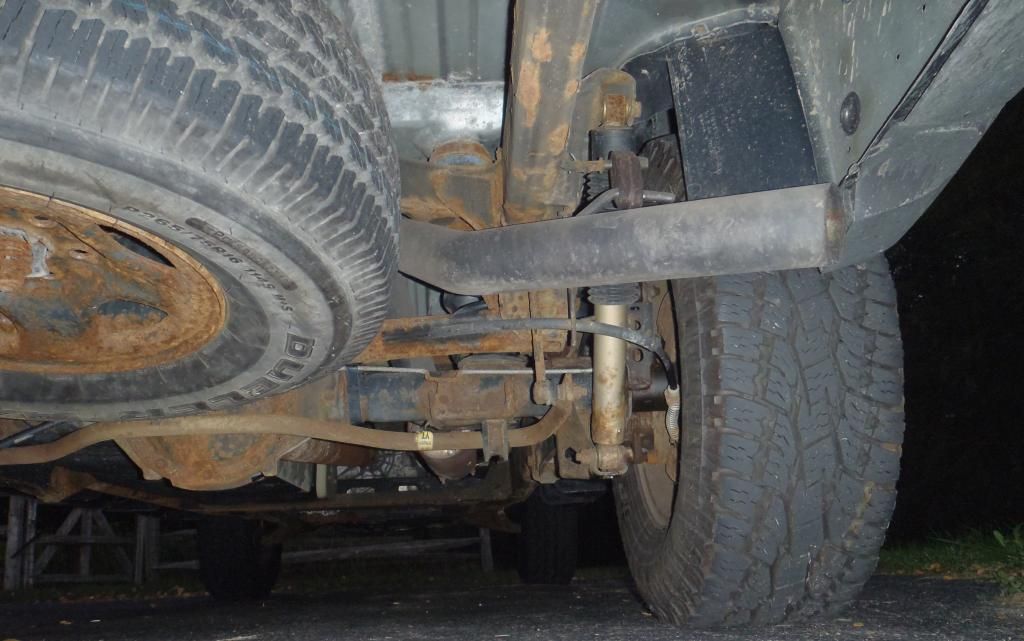
Pardon the rust and dirt
-Ross, 10/1/14