Roody's Reviews, Thoughts, and Ramblings is an automotive-focused blog intent on spreading automotive enthusiasm while simultaneously informing, entertaining, and (hopefully) inspiring. Content includes reviews, editorials, and photography, with subjects ranging from cars to quads to the art of driving...and everything in-between. Comments, questions, and criticism are more than welcome, and suggestions for an article/post will be happily accepted. Cheers!
It's 10 AM on a Wednesday early in the summer. The low diesel hum of the tow truck grows closer as we stand around the red coupe that sits on the lawn. It's stationary, immobile, motionless, call it what you want; this car doesn't run and it has a long path ahead of it before it does. My friends and I joke around but it's not enough to overcome the air of nerves, excitement, and an ominous touch of "you don't know what the hell you are getting yourself into." This is exactly how it's supposed to be.
Every car guy has their project car. For some it's the old car they've been working on with their dad since they were a kid; for others, it's a car in a video game that they only touch through a controller, spending imaginary dollars and credits to modify every bit of their virtual ride as if it were real. Then there's the guy who sends his hundred-thousand dollar supercar to a shop known for transforming "super" to "hyper," gives them a check with enough zeros to buy a house, and in turn receives horsepower figures that float somewhere in the stratosphere. Yet in between these groups lies the "every-man," the guy who starts a project out of passion, excitement, and love, simply for the sake of his own enjoyment. This is one of those projects.
Welcome to The Chronicles of the e30.
The e30 BMW is an icon. It's the epitome of late '80s and early '90s entry-level luxury, it's the car that when equipped with the ///M badge helped set the performance standard for years to come, it's the BMW of BMWs. Surprising, no: the chassis is nimble and willing to accept big power increases, the car relatively affordable and surprisingly reliable. It's the caliber of vehicle that attracts everybody, with sub-groups like those who lower them, those who race them, and those who beat them up on the rally course.
This project is going to bridge the gap between all of those groups. Think of it as that venn diagram you were taught in grade school that has the 3 big circles that overlap, leaving a little section in the middle where the color is darker and you have the best qualities from each. It's going to be a car that can be driven comfortably every day, can be taken to the track for auto-cross, and can be whipped around the unpaved roads of upstate New York without the need to change wheels, tires, or suspension setup. Easier said than done? Of course; I'll undoubtedly bite my tongue and change my mind hundreds of times as the project progresses. But for now, it's "challenge accepted."
So there I sit in the black leather driver seat of a 1989 BMW 325i Coupe that I "adopted." The car is older than myself but the odometer has only done 100,400 ticks and as such has been driven less than my 2005 Avalanche that is 16 years younger. The car's battery is old, the body an 8/10, the interior dirty but unbroken. Hours after the tow truck picked up the car and transported it to its new home in Connecticut, it's show time. My friend watches as I hold the key in the ignition, take a deep breath, close my eyes, pray silently, turn the key slowly, beg the car gods for it to start...but all we hear is the sorry sound of nothing. No crank, no spark, no combustion, nothing. The turning of the key is the only sound to be heard aside from the sighs and jumble of curses muttered under my breath. We try another ten times but there's no point, this car is dead.
Yet there's beauty in this. It's going to be a project from the beginning, from Phase I. The car doesn't start, it doesn't move when it does (blown transmission at fault), and it needs more than a fair share of attention in the vacuuming and Armor-All'ing departments. It's going to be a long, slow adventure, but it will allow me - and those crazy enough to want anything to do with an old BMW that hasn't run in years - to do everything perfectly, the way it should be done. Do it once, do it right, from the ground up. The worst part? I don't have a clue in the world what the hell I'm doing. Project e30 has begun.
Phase 1: get the damn thing running.
Project e30 will be updated as repairs, fixes, and modifications are made to the car. Check back once in a while, as I'm hoping to get it running in time to cruise the beautiful roads of the Northeast during the peak of the fall season, and if I'm lucky maybe even make it to a few races.
- Ross, 6/25/2013
Credit for the photoshop work in the first picture is to my friend Jaime
Somewhere deep in the abyss that is the world of the internet, there lies a review of the Kawasaki Brute Force in which the author calls the big-bore Kawi the "muscle car of the ATV world." He cites big power, less than inspiring handling, and a sound that works your face muscles every time the engine turns over as the vital characteristics that help the Brute to perfectly fit this description. Yet, a description is only capable of so much; more important than the power of words is the way the machine feels: the sheer, raw, startlingly brutal power; the way it's a beast to be tamed rather than a docile sports car meant for the Autobahn; the way you warn your friends who try it out to "be careful." The Brute is different from the nimble, smooth-riding, trail-friendly machines from companies like Honda, Yamaha, and Can-Am. No, the Brute's not refined, it's not easy to live with, and it's definitely not the most logical decision. The Brute is mean, it's loud, and it's almost too aggressive for its own good. Allusions to the Chargers, Mustangs, Camaros, Trans Ams, and GTO's, couldn't be more appropriate.
It's hard, if not impossible, to ignore the Brute Force's mean stance and aggressive bodywork; call it the Dodge Daytona Superbee or Plymouth Superbird styling of the quads if you dare. High fenders with angled peaks are like nothing else in the industry and the dual-circle headlight treatment is a Brute trademark. Nothing can be mistaken for a the big Kawi and you will never glance at another quad and think it's a Brute Force. Oh, and if you look at the Brute the wrong way, you'll get spanked in a staring contest. The quad simply has aggression written all over it. Instead of boring you with the less important details, I'll cut to the chase about what needs to be touched upon but doesn't require an elaborate description. Here we go: the ergonomics are fine, the digital gauge does its job displaying basic info, and the "pockets" on the front fenders are useless (although you wouldn't criticize a Superbee for its cupholders, would you?). The four-wheel-drive system works well but is fundamentally flawed seeing as very, very few people think a progressive locking front differential is preferable over a push-button on-or-off style system. That being said, all locked up in 4WD, the Brute is damn-near unstoppable. Mud, rocks, hills, you name it, the Brute will eat it up and spit the bones in your face; it's exactly what you want from your muscle car. More unnecessary though vital info: the suspension is mediocre at best, but there's the aftermarket to go to if you're a hardcore rider with a fancy checkbook. Otherwise, take it for what it is and just accept that the Brute isn't about suspension, end of story. Everything described above is adequate enough to let you focus on the really good stuff, and that's all that should matter. Remember, the Kawasaki Brute Force is a muscle car trapped in a 4WD ATV's clothing. This thing is all about the engine, and oh, does it deliver on its home front.
Words cannot do justice to the 633cc V-Twin that lives under the seat. This is a force to be reckoned with and you really do have to experience it to understand how ferocious, hilarious, and absurd the power is. From the bottom end all the way to the top of the powerband, the engine catapults the quad from a standstill to speeds you wouldn't believe are possible with such force that it truly makes one curious as to how and why bigger engines even exist. To put things in perspective, consider this: a few of my friends have looked me in the eyes after riding my Brute for the first time and, amidst the simultaneous expressions of fear and utter shock, they mumble a phrase that holds its meaning in the word "dangerous." With such a potent nuclear weapon sitting under the seat, you are only half a stab of your right thumb away from face-tearing acceleration. Use said weapon wisely.
Even better is that with a proper aftermarket exhaust, the quad can make noises at idle that force you to question whether the engine was pulled directly from a Harley, while full-throttle blasts get you thinking about if anybody has ever heard the sounds of a Ducati and a Yamaha Banshee mating. Music and force are the Brute's charms; they overcome the machine's downfalls to the point of making it worth your while every time you get on the gas. It excites, it stimulates, it creates happiness. This is what a recreational vehicle is supposed to do. If you can't laugh and smile like a fool, what is the point of riding at all? But perhaps there's something even more important than how the quad acts: it's the final element in four-wheeler ownership that solidifies its place in one's mind and soul. This final element? Passion. Corny, yes, but without the burnouts, open exhausts, and drag races, a muscle car owner/driver never would have felt the adrenaline rush, the excitement, and the love they associate with the machine. The Brute accomplishes all of this, putting a big ol' smile on your face every single time you throw a leg over it. It's the ride itself that connects a machine with its rider, thus associating one's mind with the fun that riding an all-terrain-vehicle is meant to be. The Kawasaki Brute Force isn't perfect by any means. Hell, many would call it flawed and confused. Awful suspension, good ergonomics. Uninspiring handling, power to make the gods laugh. But the quad's overall test grade is completely irrelevant: the Kawasaki Brute Force exists to put a smile on your face, to help you make the most of your time in the woods/hills/mud/whatever-your-terrain-is, and also to bring about an adrenaline rush that makes you laugh like a little girl. For this, the Brute can say "mission accomplished." It's violent, in a loving way. It's flawed, but those flaws don't matter. It's a powerhouse and it makes no apologies about it. The Kawasaki Brute Force is a four-wheel-drive, fire-breathing off-road machine that would make the muscle-car guys proud, and for that, I love it.
Video evidence of muscle car roots: I present Exhibit A.
For the last two years or so it seemed that every day a detail about the C7 Corvette would be "revealed," a spy photo taken of a C6 testing C7 hardware, or a new computer rendering drawn up for the sake of causing internet debates long enough to seemingly outlive the Corvette's 60-year history. But when the curtains were drawn, the smoke cleared, and the official vehicle rolled onto the stage before the press at the Detroit Auto Show, the only words that could be uttered were those of awe, shock, and slight confusion. After years of anticipation, it took just moments for the actual C7 to spark great controversy and simultaneously put the entire automotive industry on notice.
For generations the Corvette was the poster child of the affordable American sports car. Powerful, light-weight, and accessible to the average working man, the 'Vette was the icon you grew up dreaming about, the sports car you worked day-in and day-out to afford, and the investment you made when your kids were finally out of the house. But those stereotypes began to vanish with the C5 when Chevrolet introduced the Z06, an even higher-performance, more track-oriented model, and by the time the C6 Z06 and the world-crushing ZR1 came around the Corvette was no longer "go-to" car for the 50 year-old male going through his mid-life crisis; no, the Corvette was the epitome of world-class, near-supercar performance at a price you would never expect. Even the base C6 was capable of low 4-second 0-60 times, top speeds approaching the magic 200 MPH mark, and handling abilities that were on par with the Germans and Italians. Introduce the C7 and those performance standards have been raised even higher. But GM easily could have left it at that; instead, they employed their most talented and creative designers to create the C7 as not only a new Corvette, but as a vehicle that will represent the brand, stand out in even a crowd of Italian supercars, and truly be the image of the American Revolution they were looking for in their 2004 ad campaign.
To put it simply, the C7 is unlike any Corvette we have ever seen before. Sure, there are similarities to the C6 (especially one of the wheel options, which looks like a carryover from the previous generation), but the details go so much further. And although it is a Corvette in spirit, motor and heart, it truly does take design cues from many other vehicles on the road today -- and that is by no means a bad thing.
Look at the front end of the C7 and you get eyes full of C6 Vette and an equal amount of Viper. The open grille looks like it was pulled directly from the two cars, with the engineers having their say and allowing the opening to suck in as much air as possible. It's not a drastic change from the C6, but there is an undeniable resemblance to the snake-bitten V10-bearing supercar built by Chevy's American rivals. Meanwhile, the hood is vaguely reminiscent of the C6 ZR1's window-style setup, featuring louvers in place of the see-through section, with intent on keeping the engine cooler (more emphasis on performance is never a bad thing for a Corvette) and a contoured look that is more shapely and detailed than before. The headlights, which are a big change from the C6's, look as if they were just slightly modified after being pulled from a Ferrari 458. Influences from the SRT Viper, Ferrari 458, and the company's own ZR1 in the front end alone? Not a bad place to start by any means.
On a related note, here's a fun story about the Corvette and the Viper: when Dodge (now SRT) ended production of the 4th Generation Viper in 2010, outrage and sadness echoed through the crowd of enthusiasts who loved the car for its raw power, lack of electronic nannies like traction and stability control, and for portraying the brutal American supercar. Shortly after, Dodge released a statement announcing the Viper would return albeit with the influence of parent company Fiat/Alfa Romeo, and the internet world went into uproar as expectations of a Viper based on the Alfa 8C began immediately. But SRT proved us wrong and brought an all-new Viper modernized with everything one would expect in a 2013 model year vehicle, though still bearing its evil Viper genes. The all-new SRT Viper was supposed to be the the pinnacle of American performance this side of the Hennessy Venom GT, and finally Motor Trend got their hands on the Viper in a track battle against a similarly-priced C6 ZR1. Guess who won the lap time battle at Mazda Laguna-Seca? In outrage, SRT built a "TA" version of the Viper and had MT run it against the ZR1 again, just barely beating the monster Vette in its second chance, and also setting a record lap time around the track (the ZR1 did the same in their first battle). Yet this was the C6 ZR1; when the C7 ZR1 bows Chevy will easily once again reclaim the title. It's interesting how in a time when Chevy brags about the C7 getting around 30 MPG highway that their cars are still fighting to be as high-performance as feasibly possible. It's an age when performance isn't necessarily compromised by efficiency, the best of both worlds finally coming together.
Back to the design critique: I was at a friend's house looking at his dad's '80 Stingray Coupe and was shocked by the details and small cues that the C7 Stingray shares with the older cars. The main detail that caught my attention was the rear fender; on the 3nd generation car, it looks like all that is missing is the black vent from the C7 and it would be nearly identical. Hopefully (and most likely) this was intentional, for the lines and curves are almost perfectly reminiscent in a modernized sense. The fact that the vent is functional makes it that much better, too. (Note: pictured is a 2nd gen. Sting Ray)
The rear end is arguably the most important part of the car, and for better or worse this is the area that causes the most controversy. What's the one staple of a Corvette that's been on every generation since 1961? Similar to the Jeep Wrangler (which has round headlights), something just seems wrong or strange with a Corvette's taillights being anything but two big circles on each side. [There's a reason many Jeep owners replace the 1987-1995 YJ Wrangler's front end with the CJ's classic round-headlight bearing grille.] Yes, the vents on the outside of the lamps win bonus points for being functional, and yes, the new rear end does align the Corvette more with the Camaro that is being used to dictate much of Chevrolet's product line, but this is hard to explain to Corvette faithfuls. Prior to the C7, anybody driving behind a Corvette could tell it was so by its trademark taillights, but the C7 is a huge departure from this. As much as I'd like to side with Chevy's designers I can't help but be a little critical and concerned; I'll reserve my final judgment until I see a C7 in person. But for now the taillights are the sole area of concern; yes, I wish they were round, or wish that at least the exhaust tips matched the lights, but it does have an air of attitude to it. Kind of like a good Transformer after going to the Dark Side.
The profile of the C7 is another striking detail. Longer, lower, and with the cabin sitting more towards the rear of the car than in the C6, there is almost a Ferrari 599 look to it. Again, not a bad car to resemble. The black A and B pillars help to make the roof look lower than it is and give it the appearance of being smaller as well. One can only imagine how great a targa version will look with the mid-section of the roof removed.
So what we have here is a Corvette with an entirely new design and a drivetrain/technology combination that will help it keep up with some of the world's best performance cars. And if it drives as we expect it to, it will continue to be the great American performance value, leading the way for Chevrolet into the future and proving the rest of the world that right here, in the good 'ol U.S. of A., we still build cars that can take on and beat the rest of the world. Hopefully Jeremy Clarkson will give it his seal of approval.
Back in 2004, Chevrolet began its "An American Revolution" ad campaign, telling of the new models to be released, notably the SSR, HHR, and the C6 Corvette. Five years later, Chevy dropped the campaign only to replace it with "Chevy Runs Deep." Perhaps it is time to re-employ the campaign that showcased the C6, for the 2014 Corvette C7 Stingray is truly An American Revolution. No other Corvette has been as shocking, as forward-thinking or as important in the company's history. As the poster child for one of America's oldest brands, Chevy needs the C7 Stingray to sell well, especially because it bears one of the most legendary names in American car history. With new technology, a new interior (finally, appropriate seats for a Corvette!), a new body, a new engine (with the familiar old LT1 name), a 7-speed manual transmission, and millions of people watching, it is time for Chevrolet to to show the world that 60 years of Corvettes has turned it not into just a car to drool over as a child but into a car that can keep up with the best of the world while maintaining the everyday drive-ability and the heavenly V8 sound that makes a Corvette fulfill its 1963 slogan, "The Most Exciting Car In America Today." The affordable do-it-all American performance car is about to take on the world, taillights and all -- and with a name like Stingray, it better be good.
For now (even though the car featured is a C6), I leave you with this video.
Think of somebody you know who has never turned a wrench. If you give them a job that starts with choosing the appropriate tool, do they know where to start? Doubtful, at best. Now think of somebody you know who has zero knowledge of pickup trucks; would the situation be any different if you told them to walk into a Chevrolet dealership and, unassisted, choose the right truck for the job you assign them? Not a chance in the world. But the people who know that pickups are more than a one-breed species also know that there are different options for different jobs and different lifestyles. A carpenter wouldn't use a paint brush when he needs a nail gun, would he? Luckily, Chevrolet's toolbox was assembled by somebody who is fluent in the language of Truck.
Let's call the Chevrolet Avalanche a Swiss Army Knife and the Silverado HD a sledgehammer. Both are tools, each serving a completely different purpose. But first let me be completely clear: this is not a comparison to see which is the better vehicle. Picking a winner would make about as much sense as comparing a chainsaw and a 100-piece Craftsman set. Rather, this is about illustrating how two stablemates bearing the same badge can be built for such different purposes, just as Craftsman sells do-it-all tools alongside purpose-driven implements.
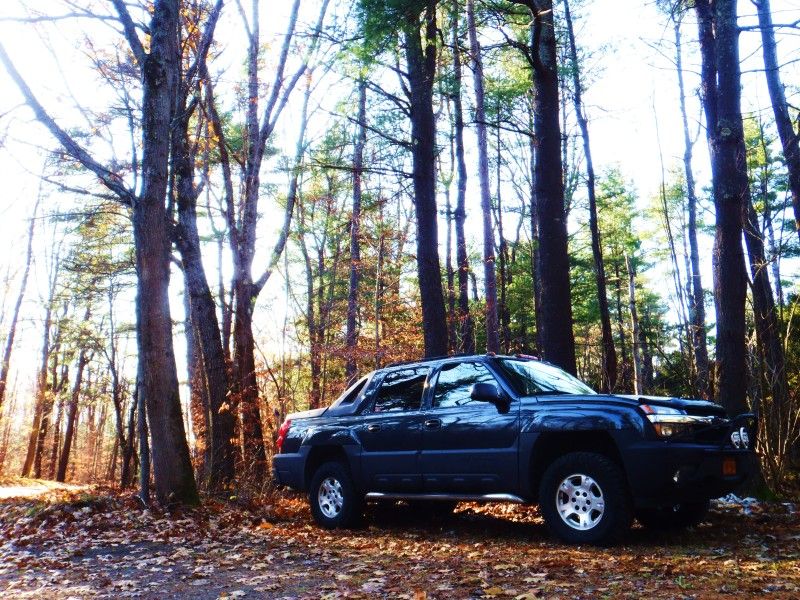
Another note: the trucks in this "comparison" are by no means new. With 112,000 miles on the clock, the 2005 Avalanche Z71 we have here is starting to show its age. Despite its mechanical near-perfection, the truck appears to be in great condition from a distance until you inspect it up close and notice the dings, nicks and scratches hiding in the Dark Gray Metallic paint. Oh, and then there's the under-body rust. Snow might be fun, but road salt is the devil. All things considered, this truck is still in great shape for the abuse it's withstood over the years (looking back, 2500 pounds of dirt in the bed may not have been the best idea...).
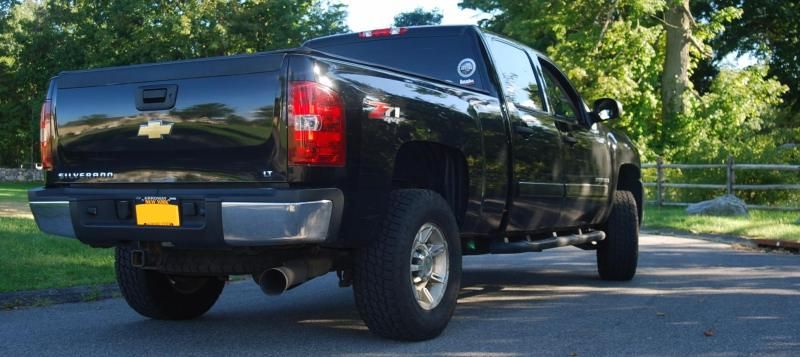
The Silverado here is from late 2007, the first year of the GMT900 vehicle code, or one generation newer than the 2005 GMT800-series Avalanche. My dad's black 2500HD Crew Cab 4x4 LT has 110,000 miles on the odometer but you would never guess that simply by looking at it. Not only are the exterior and interior in great shape, but 110K is just getting broken in for the Duramax diesel. 200K miles should be easy with basic maintenance; he's shooting for 300K and shouldn't have a problem getting there.
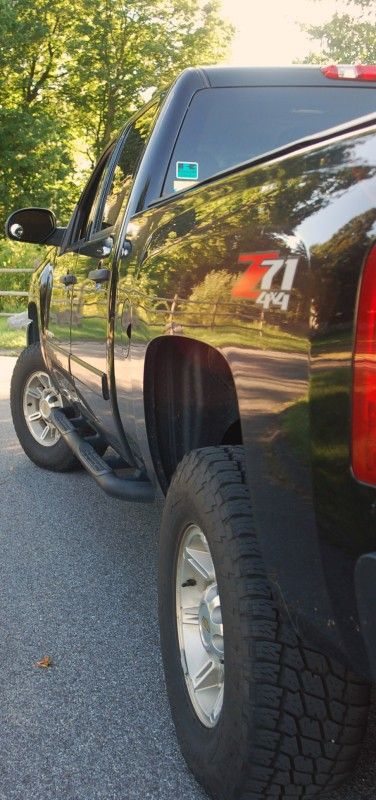
Parked next to each other, the two trucks give off the overwhelming sense of aggression and capability. The Avalanche's pre-runner style bumper (originally on a 1998 GMC Yukon), leveling kit and meaty Goodyear Wrangler Duratrac tires give it an in-your-face, "get-out-of-my-way, deer!" attitude. Amber roof lights typically found on a 2002-2009 Silverado HD accent the running lights of the same color and differentiate it from other Avalanches. The combination of modifications make this a one-of-a-kind truck, and I've gotten waves from a bunch of other Avalanche drivers and stares from countless onlookers. On the other hand, the Silverado doesn't need anything to make it look like a king-of-the-hill pickup. This thing means business, and with the torsion keys cranked to add about 2" of height up front, the stance is menacing. Nitto Terra Grappler tires and Hummer wheels contribute even further to the air of intimidation that it gives off. Small cars don't stand a chance.
It's obvious that the Avalanche's interior is outdated as soon as you open the door and climb inside. Credit this to GM's use of the parts-bin concept, which gave all of same-generation trucks a nearly identical cabin. Hell, climb in any Avalanche, Silverado, Tahoe or Suburban from the 2001-2006 generation and you'll be hard pressed to tell the difference unless you turn your head 180 degrees. Materials are so-so (there's hard plastic everywhere), the buttons are all within reach, and the seats are superbly comfortable. I spent eight hours in the driver seat with only a ten minute stop for gas and was barely sore upon exiting the truck (and this was with 99,000 miles on the seats, way past their prime).
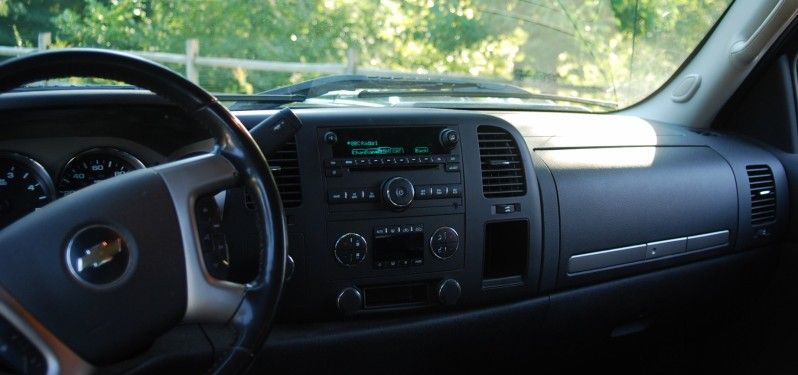
Though the Silverado here is a generation newer than the Avalanche, GM really dropped the ball on the interior quality. Everything is laid out fine, with easy-to-use buttons (for the most part...I'm looking at you, radio controls) and clever storage solutions, but while the earlier trucks were upfront and not afraid to hide the fact that their interior is Hard Plastic City, the Silverado fails at trying to conceal this. The material quality simply isn't on par with what those in a 2007 model year vehicle should be, pickup or not. It seems like a minor detail when the primary focus for a truck isn't comfort, but hard plastic still becomes irritating when there's so much of it. Most of your time is spent in the driver's seat, don't you want it to be a nice place to be? Sure, the interior is adequate overall, but it could have been so much better.
In terms of packaging, the Silverado is a truck and not much more. The rear seat folds up which allows for a wide pass-through cargo area and the center console has a few neat storage solutions, but that's the extent of it. However, the Chevy engineers truly out-did themselves when designing the Avalanche's utility specialties. With the debut of the Avalanche, Chevrolet introduced a load of innovation that added substantial amounts of utility to what everyone thought was possible from a pickup. The fact that it can transform its full-size SUV cab (it is based on the Suburban) to full-size eight-foot bed in only a couple of minutes (or seconds, depending on your proficiency) is astonishing to those who haven't seen it done before. Want to wow somebody? Show them how the mid-gate works.
The ingenious system's main attraction is the "mid-gate," a folding
divider between the cab and the bed along with a rear window that can be
removed and stored safely on the inside of the previously mentioned
divider. This was a huge break-through (pun unintended), and it's a
level of engineering ingenuity not usually seen in pickups, let alone
those from General Motors in the early 2000's. Add in the three hard
panels that cover the bed (as well as the locking tailgate) and you have
a fully enclosed and secure cargo spot, perfectly safe for whatever you
throw in there. The number of possible configurations is astonishing;
any of the panels can remain on the bed while you do whatever you please
with the mid-gate (fold the midgate/keep window in place; remove
window/keep midgate in place; remove window/fold midgate; leave both in
place -- and combine any of these with any assortment of panel assembly
that fits your needs). Just knowing you can convert the SUV into a
truck provides a peace-of-mind experience; pretty much anything will fit
in here, and safely, too. And just for fun, remove the panels, take
out the window, drop the midgate and roll the windows down. It's as
close as you'll get to a convertible truck this side of an SSR.
Additionally, there's the "saddle bags," locking, water-tight storage pockets located on the back of the truck between the sheet-metal and the inside of the bed. Road flares, gloves, jumper cables? Throw them in the saddle bags and they'll never get in the way of cab or bed use again. Proof of brilliance? In 2009, Dodge coined the "Ram Box," an exact replica of the saddle bags, 8 years after Chevrolet included it in the original Avalanche.
Now the fun part: engines. Think of the Avalanche's 5.3L V8 (295 HP / 330 lb-ft.) as a local power station: it supplies a lot of power - enough for the town (the driver's use of the truck) - but nothing more. Acceleration is adequate and passing power is, well, passable. If you really need to get by somebody I'd recommend using the Tow/Haul mode which drops the transmission down into a lower gear and then holds it all the way to red line, all while making absolutely glorious sounds. In this application, the biggest redeeming quality about the Chevy small block is the exhaust note. The classic engine, custom pipes and Magnaflow muffler make for a sound that will shake your insides. Close your eyes and listen to the exhaust clip below, what's that sound? A Corvette? A Camaro? A Firebird, GTO, G8? Nope, not even close. That's the Avalanche, and it freakin' roars. Watch the video below for evidence.
(Turn your speakers waaaay up or put in some good headphones. Seriously.)
[No, I don't know if it will pass emissions next year.]
And then there's the Silverado HD's 6.6L Duramax diesel nuclear power plant. 660 lb.-ft. of torque motivate the truck well enough to scare those who aren't accustomed to hard acceleration in something tipping the scales at 7,000+ pounds, and with only an aftermarket intake, the best word to describe the heavyweight's acceleration is "violent." Once a tuner and proper free-flowing exhaust are added the truck should easily keep up with hot hatches and rental V6 Mustangs from a dig. Call it the most terrifying and unexpected of sleepers.
Towing a 3,000-pound trailer, the Avalanche struggles slightly...compared to the 2500HD. It barely breaks a sweat pulling at 65 MPH, but 3rd gear is used more frequently than you'd like (say hello to exhaust drone). Remember that old 4L60E transmission? Two more gears surely would help. Hell, even one more would help, as the 4-speed tranny is outdated and borderline inadequate. The Silverado? It tows as if nothing's there. I've had friends tell me, literally, "it's like there's no trailer and no load...diesel is awesome." Combined with the 6-speed Allison transmission, this truck is the perfect tow rig. A trailer helps to weigh the rear end down just enough to make the ride a little more compliant, and the engine will do anything you want it to. Give a non-diesel driver one quick stint behind the wheel and they're an instant convert.
The power that the diesel provides is other-worldly compared to the conventional gas engine in the Avalanche. At any speed, in any gear, put your foot down - wait for it, wait for it, (tranny downshifts), wait for it (spooling!), then - holygodballs, what is this thing?! Windows down, the noises coming out from under the hood are like aural crack, and since you're used to acceleration like this coming from a vehicle that sits what seems like 50' closer to the ground and weighing about half as much, it's an absolutely polarizing experience. Stepping hard on the hammer pedal to drop down a few gears and hear the spooling of the 61mm turbo, the whoosh of air, and then feeling the acceleration that shakes the truck as it tries to force the Earth into reverse orbit beneath itself - it's addicting, and something you would never expect from a truck whose reason for existence is towing and hauling.
Complain all you want about diesel fuel being hard to find but the power advantages and tuneability of the engine make it completely worth the sacrifice. Hell, towing a trailer and not having to downshift on even the steepest of highway hills makes the initial cost versus a gas engine seem worth it. There's reasons why diesels have such a massive fan-base, and the Duramax makes it easy to understand.
The extra power not only makes the 2500HD more fun but a little safer as well. Coming down an entrance ramp and need to make a fast pass around that 18-wheeler that's about to block your lane? Not a problem, step on the gas and it's done. Climbing a rough hill with a trailer to get to the parking lot at an ATV trail? The transmission and ability to select gears are more than up for the job. I wouldn't call the Avalanche unsafe, but the diesel's power and torque give you the mindset that you can literally overpower any challenge, be it a slow-moving vehicle in the left lane or a hill that would put lesser trucks' thermometers in the red zone.
However, ride quality is a completely different game. Bumps, potholes, and rough roads are the Silverado's worst nightmare. Seriously, avoid broken roads at all costs. Yet this is the Northeast, and driving on poorly maintained pavement is a fact of life. The ride quality (or lack thereof) has to be expected though considering the Silverado's leaf springs out back, stiff front suspension and the overall mass it carries around. The Avalanche, on the other hand, does fairly well in daily driving (as it should; remember, it's a Suburban under the skin).
Another difference is the four-wheel-drive systems in each truck. The Silverado uses a knob to switch from 2WD to 4WD to 4WD Low that is located on the right side of the steering wheel, where it is easy to find and equally easy to use. The Avalanche offers one more option, 4WD Auto, which enables the truck to use an all-wheel-drive style system to sense slip and engage 4WD on its own. To be honest, I have never used this feature in four years of ownership, but it's a good to have if a less experienced/confident driver was to be behind the wheel in less-than-sure road conditions. Unlike the Silverado, the Avalanche uses buttons to the left of the steering wheel for selection of how many corners put power to the ground, and this setup works just fine but is a little less logical in an ergonomic sense.
On a day-to-day basis, the Avalanche is definitely the easier of the two live with. The 19" difference in length, the turning radius, the greater availability of regular unleaded fuel, and the general driving characteristics make it the clear choice if you don't need a Heavy Duty pickup daily. Gas mileage is a wash because while the 2500HD can go further on a gallon, its liquid propulsion costs more and thus they're just about even in terms of cost-per-mile. A note on visibility: you can see everything looking out of the Silverado, but the Avalanche's rear visibility massive blind spots can cause trouble merging, parking, and maneuvering. Still, it's not bad enough to drastically affect everyday driving.
So all things considered, let's call the Silverado a sledgehammer; it's strong and extremely useful in splitting wood or breaking heavy objects - but pushing it outside of its element is asking a little too much. The Avalanche is more of a Swiss Army Knife, a tool good at a wide variety of things but not spectacular at anything in particular. What it does do best is combine the utility of a large selection of tools and applications into one just-the-right-size package. Let's see a sledgehammer break out its screwdriver or file attachment, or the Swiss Army Knife split wood. But hang on a second, this wasn't about picking the better truck but exploring how different two full-size Americans pickups built by the same manufacturer can be. Pointless? Sort of. But then again, so is having a workshop filled with only one tool. Chevrolet did one hell of a job differentiating two of their full-size pickups, and I can honestly say the engineers did a commendable job overall of allowing these two trucks to exist and be sold under the same brand name with enough of a difference between them for each to make a compelling point for itself. Well done, Chevy - you successfully filled your stable with two different breeds of the same species, and made them both worthy of ownership.
But the end of the day, which truck would I want to own? The packaging of the Avalanche is near perfect: a plethora of utility, a relatively conservative size, and a look all its own. It was the pickup/SUV love-child that literally came out of nowhere, but one that Chevy executed damn-near flawlessly. Yet there's just that "something" missing, something the Silverado has, that the Avalanche cannot compete with; that "something" takes form in the 6.6L Duramax turbo-diesel engine. This alone is reason enough to love the Silverado; call it the sole advantage over the Avalanche (all of its added benefits - towing, hauling, etc. - are in some way related to it), but it's that good. Going from driving the Silverado to driving the Avalanche is a disappointment whenever you have to accelerate, especially with the sound of a Corvette echoing throughout cabin and the truck just not having enough bite to back up its bark. Deciding which to own is nearly impossible; it's like deciding to marry a girl who is stunningly beautiful with a decent personality or one that has a perfect personality and isn't all that exciting to look at. The Silverado definitely isn't the beauty queen but it sure has a hell of a personality; if I were to buy a new truck, this is the one I'd want to come home to every day.
Bottom line: what I've discovered through years of having an Avalanche and a Silverado in the same household is that it is very possible for a company to offer multiple trucks without having them step on each others' toes. The Avalanche and Silverado exist for entirely different reasons and both do their respective job incredibly. Unfortunately, 2013 is the end of the production run for the Avalanche as lack of demand will be sending it to the great car crusher in the sky, but the Silverado will soldier on for another generation. Long live the Chevy truck, whatever form it takes.
So for everyone else, as expected, it comes down to needs and wants. Need a truck bed but don't want a monstrous full-size Heavy Duty pickup? Buy an Avalanche and walk away happy with its SUV-like ride, easy-to-use utility and storage capabilities. Want power? Buy the diesel Silverado. Need a truck that can tow and haul with the best of them? Obviously that's not what the Avalanche was designed for, but if you're a weekend warrior towing a light ATV trailer and need a bed to throw muddy gear in, the Avy is right for you. If you need more of a "truck" though, go buy a Silverado, install an aftermarket intake, performance chip and exhaust and bask in the glory of the Duramax. Accept its shortcomings, learn to tolerate its ride quality, pretend the interior is nicer and go surprise a Mustang at a stop light. End of story.
But what about in a perfect world? A utopia where the best of everything can come together to make the world's best pickup truck, with the backbone of an Avalanche and the heart of a Duramax Silverado? This, my friends, would be truck heaven. Power, comfort, and utility, all packaged in one controversially-styled yet totally badass looking truck that's a hoot to drive and a true work companion when it's needed. Absolute perfection in the truck world. Thank god for the aftermarket and for shops willing to do engine transplants, otherwise a combination this good would only exist in truck lovers' imaginations. Hypothetically speaking, what would I do with the Avalanche if the engine were to die long before the truck itself, replace it with another small-block Chevy motor? That would be like giving Superman a human's heart after it stops pumping blood. There's just something about the sound of that turbo spooling that I can't stop dreaming about...now that would be the sole tool to replace all of the inferior tools wasting space in my toolshed.
- Ross B.
Feel free to e-mail with comments, questions and/or suggestions!
2005 Chevrolet Avalanche Z71 4x4
Daystar leveling kit, HD roof lights, Airaid intake, custom exhaust pipes w/Magnaflow muffler, 285/70-R17 Goodyear Wrangler Duratrac tires, pre-runner style light bar w/Hella lights, black bowtie, CB & antenna, amber running lights, front lip removed, bumper-mounted reverse lights
2007 Chevrolet Silverado 2500HD 4x4 LT w/Duramax diesel
Banks intake w/"Super Scoop," Hummer H2 wheels, 295/70-R17 Nitto Terra Grappler tires
Credit for all un-sourced photos: Ross & Spencer B.